

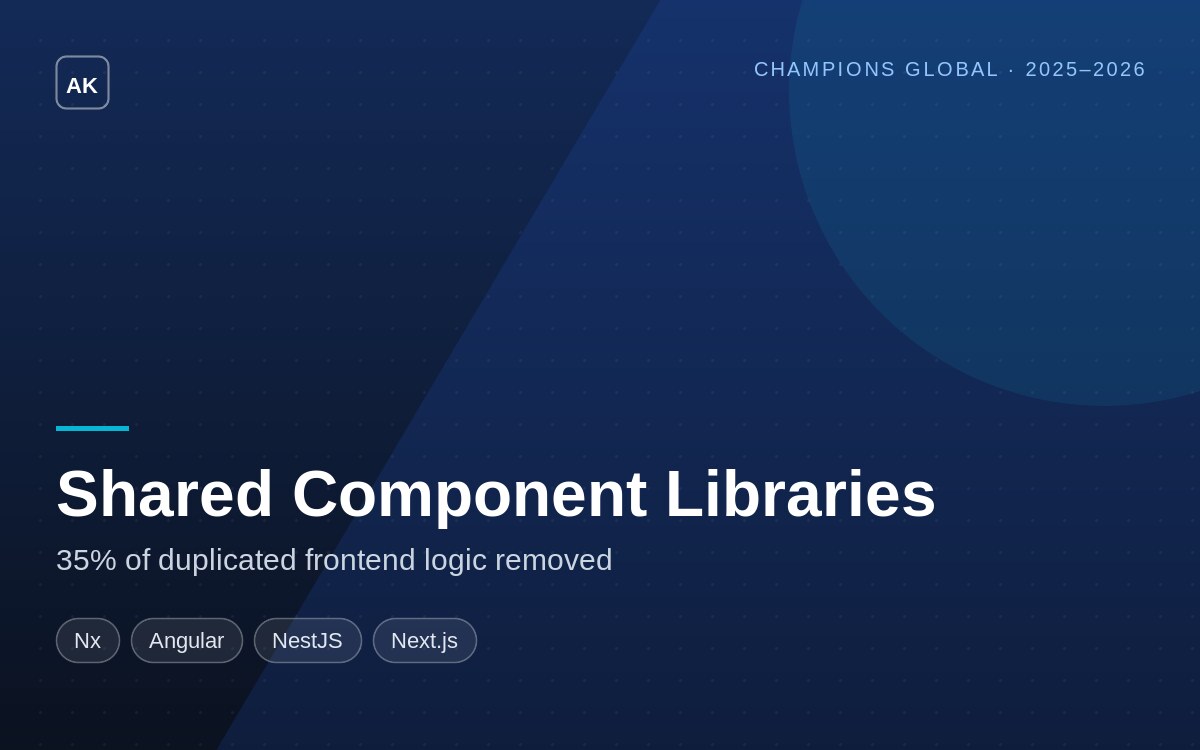
Nx Monorepo — Shared Angular Component Libraries
The problem
Champions Global builds and maintains platforms for its clients, and the same interface problems kept being solved again in every codebase — the same table, the same form control, the same widget, written slightly differently each time. Duplication like that is cheap on day one and expensive forever after: a single fix has to be applied in several places, and the copies drift until they behave differently for no reason anyone can explain.
My role
Backend engineer on a fourteen-month engagement, working across the stack on client platforms that stay unnamed here. Alongside the API work I built the shared Angular libraries that this case study is named after. Consolidating shared UI is as much a social problem as a technical one — a library only survives if using it is easier than copying the file next door — so the work was equally about the process around it.
Architecture
- Reusable Angular component libraries and shared modules inside an Nx monorepo, so a component has one implementation, one test suite and one place to fix — and the Nx dependency graph makes it visible which applications a given change actually touches before it merges.
- Backend services in PHP (Laravel and Symfony) and Node.js (NestJS and Express), designed as clean-architecture REST APIs so the business rules stayed independent of whichever framework happened to be carrying them.
- Next.js frontends delivered end to end against those NestJS and Express APIs.
- Real-time features built with Socket.io where the product genuinely needed live data rather than a refresh button.
- WordPress and Shopify storefronts integrated with custom backend services, so a client could keep the storefront their team already knew while the logic that mattered moved behind an API.
- Contributions to the CI/CD workflows and the monorepo development process — the unglamorous part that decides whether shared libraries stay shared or quietly fork back into copies.
Technologies
Angular, TypeScript, Nx, Next.js, NestJS, Express, Laravel, Symfony, Socket.io, WordPress, Shopify.
Outcome
Duplicated frontend logic dropped by 35%. The number is the headline, but the durable part is what it represents: a component library teams reach for by default, a monorepo where a shared change is one pull request instead of five, and pipelines that prove the change is safe across every consumer before it lands. The engagement ran from March 2025 to April 2026.